Exendin-4: From lizard to laboratory...and beyond
Throughout history, the natural world has served as a rich resource for compounds to treat human disease. For example, clay tablets from Mesopotamia dating from 2600 B.C.—humanity’s earliest written records—describe the healing powers of several plant species, including licorice, myrrh, and poppy capsule latex. More recently, penicillin and other lifesaving antibiotics have been developed from fungi, anti-cancer drugs paclitaxel and camptothecin have been derived from tree bark, and the powerful painkiller ziconotide has been synthesized from the venom of the sea-dwelling magical cone snail.
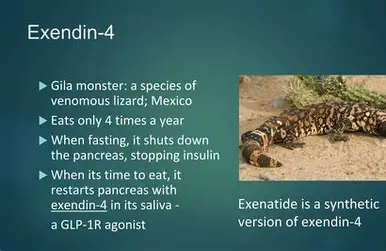
To this diverse catalog of natural sources for modern therapeutics we can add the unassuming Gila monster (Heloderma suspectum), a poisonous lizard found in New Mexico and Arizona. H. suspectum is long-lived but shy, spending up to 95 percent of its life underground. Encountering a Gila monster above ground can prove unpleasant. When it bites, its venom can cause pain and weakness but is rarely fatal to adult humans. And now, NIA scientists are using part of that same venom to develop promising new treatments for Alzheimer’s disease, diabetes, and other diseases common to older age.

The component of the Gila monster’s venom of greatest scientific interest is a peptide known as exendin-4. With the help of researchers in the NIA Intramural Research Program, investigators developed a synthetic form of the component—exenantide—which is now used to treat type 2 diabetes. Under the trade name Byetta®, exenatide is commonly prescribed to boost the effectiveness of patients’ primary diabetes treatment. (It is not prescribed for the less common type 1 diabetes, an autoimmune disease.) Today, scientists are testing exenatide as a possible intervention for Alzheimer’s disease.
Looking at lizards
Exendin-4 was uncovered in 1990 by endocrinologist Dr. John Eng at the Veterans Administration Center in the Bronx, NY. Dr. Eng was using chemical assays to identify new hormones and was intrigued by earlier NIH research showing that venom from certain snakes and lizards, including the Gila monster, caused enlargement of the pancreas, where insulin is synthesized. That research suggested that the compounds were somehow overstimulating the pancreas.
Dr. Eng’s interest was sparked when he learned that the Gila monster, after long periods of not eating, is able to slow down its metabolism and maintain constant blood sugar levels without affecting its health. He assayed the venom and discovered a peptide he called exendin that triggers synthesis and release of insulin from beta cells in the pancreas.
To his surprise, Dr. Eng found that exendin-4 was similar in both structure and function to GLP-1, a hormone found in the human pancreas that stimulates insulin production in the pancreas, but only when glucose production is high—for example, immediately after a meal. GLP-1 remains active in the body for about 2 minutes, but exendin-4 remains active for hours, suggesting that it could be a long-acting, effective diabetes treatment.
Examining a drug for another use
In the 1990s, NIA researcher Dr. Josephine Egan and colleagues teamed with Amylin Pharmaceuticals to begin preclinical testing of exendin-4. By 1999, they reported that a single daily injection of exendin-4 given to diabetic mice was sufficient to normalize blood glucose concentration, with benefits evident by the end of the first week of treatment. Dr. Egan and her collaborators later found that exendin-4 increased insulin production and protected the insulin-producing cells against damage in humans, and that its effects lasted for hours. After further clinical testing, it was deemed to be safe and effective, and it received FDA approval in 2005.
But the story doesn’t end there. While studying the effects of exendin-4 on the pancreas, Dr. Egan and her colleagues found that it also seemed to have beneficial effects on the brain. Specifically, GLP-1 stimulates the growth of neurites (developing neurons) in cell culture, and both GLP-1 and exendin-4 protect mature neurons against cell death. In fact, research increasingly suggests that there may be a link between some neurodegenerative disorders and metabolic dysfunction. The hope is that drugs, such as exendin-4, that enhance metabolic function may also be useful in the treatment of neurologic disease.
Building on these findings, Dr. Egan and others in the NIA Intramural Research Program have tested exendin-4 in cellular and mouse models of several neurodegenerative diseases. The results are promising. For example, using a mouse model of Huntington’s disease, they found that exendin-4 reduces the accumulation of the mutant huntingtin protein, which is implicated in the disease’s onset and progression. The treatment also improved motor function and extended the survival time of the Huntington's disease mice.
In other studies, investigators found that exendin-4 significantly reduced levels of amyloid beta protein (a hallmark of Alzheimer’s disease) and its precursor molecule in mice models of the disorder. It also proved beneficial in cellular and animal models of another neurodegenerative disorder, amyotrophic lateral sclerosis (ALS), or Lou Gehrig’s disease.
Alzheimer’s clinical trial now recruiting
NIA is now recruiting volunteers for a clinical trial of exendin-4 among older adults with either early-stage Alzheimer’s disease or mild cognitive impairment (MCI), which often leads to Alzheimer’s. Participants must be age 65 or older, have memory complaints, and live in the Baltimore area.
“We’re very excited about this study,” says lead investigator Dr. Dimitrios Kapogiannis. “The unexpected finding that exendin-4 has neuroprotective effects in animal models of various neurodegenerative diseases opens the door to testing this drug as a treatment for a number of devastating human diseases, such as Alzheimer’s.”
“I think the fact that we have been able to take this substance found in nature and consider applying it in such incredibly diverse ways—to treat diabetes, to possibly treat neurological disease—adds to the growing body of support for a link between the endocrine and nervous systems,” adds Dr. Egan. “This research also demonstrates a new way to think about therapeutics. Instead of ‘one drug, one disease,’ we should think of designing drugs that impact multiple diseases.”
Exendin-4: A GLP-1R Agonist
Type 2 diabetes is a chronic metabolic disorder characterized by elevated blood sugar levels and impaired insulin function. Over the years, researchers and pharmaceutical companies have been striving to develop innovative therapies that effectively manage the condition and improve patients' quality of life. One such breakthrough in diabetes treatment is Exendin-4, a remarkable peptide with potent glucose-lowering effects. This remarkable peptide was originally isolated from the saliva of the Gila monster lizard (Heloderma suspectum). It has proven to be a potent agonist of the glucagon-like peptide-1 receptor (GLP-1R) and activates various signaling pathways involved in multiple biological activities, such as cell apoptosis, insulin secretion, and microglial cell inactivation.

Figure 1. Exendin-4, a GLP-1R agonist plays a vibrant role in various biological activities such as apoptosis, Beta-cells proliferation, and glucose through different signaling pathways.(Source: Rajabi, H. et al., 2022)
Mechanism of Action
Exendin-4's mechanism of action revolves around its binding to the GLP-1R and subsequent activation of intracellular signaling pathways. Once administered, Exendin-4 exhibits high affinity and specificity for the GLP-1R, which is primarily located on pancreatic beta cells. Upon binding to the GLP-1R, Exendin-4 triggers a cascade of events that lead to improved glycemic control. One of the primary signaling pathways activated is the cyclic adenosine monophosphate (cAMP) pathway. Activation of this pathway ultimately results in increased intracellular cAMP levels, which play a crucial role in regulating glucose homeostasis.
By binding to GLP-1R, Exendin-4 stimulates insulin secretion from pancreatic beta cells. This effect occurs in a glucose-dependent manner, meaning that insulin release is enhanced when blood glucose levels are elevated. The amplification of the insulin response helps to maintain optimal glucose levels in the bloodstream. Furthermore, Exendin-4 inhibits the release of glucagon, a hormone that raises blood glucose levels. By suppressing glucagon secretion from pancreatic alpha cells, Exendin-4 reduces the production of glucose by the liver and prevents excessive glucose release into the bloodstream.
In addition, Exendin-4 influences gastric emptying and appetite regulation. It slows down the rate at which food moves through the stomach, leading to increased feelings of satiety and reduced food intake. This effect is especially beneficial for individuals with type 2 diabetes and obesity, as it can contribute to weight loss and improved metabolic parameters.
Clinical Efficacy of Exendin-4
Effect of Exendin-4 on epitheliogenesis and cutaneous wounds
Ex-4 has a significant impact on epithelial growth and skin wound healing. It reduces the accumulation of pro-oxidants and byproducts that lead to cutaneous and gastric wounds in diabetic individuals. Ex-4 administration decreases superoxide anions and serum IL-6 levels, promoting a decrease in inflammation and oxidative stress. It has angiogenesis potential, increasing tubulogenesis rate and enhancing protein levels associated with angiogenesis. Ex-4 also induces keratinocyte proliferation and diminishes the frequency of gastric ulcers by suppressing inflammation and oxidative stress, thus accelerating healing and confining ulcer progression.
Effect of Exendin-4 on cancer
Ex-4 has demonstrated anti-cancer properties, inhibiting the proliferation and metastasis of breast cancer cells and promoting apoptosis. It modulates key effectors involved in cancer progression, such as Caspase-9, Akt, and MMP-2. Ex-4 also attenuates ovarian cancer cell proliferation and confines tumor mass via the GLP-1R signaling pathway. In pancreas and prostate cancers, Ex-4 reduces tumor size, stimulates cytotoxic T cells, and modulates regulatory T cell function. Moreover, Ex-4 sensitizes cancer cells to radiation and shows promise in preventing cachexia and reducing insulin levels in tumor-bearing subjects.
Effect of Exendin-4 on neurodegenerative disorders
Ex-4 exhibits neuroprotective effects in the CNS by inhibiting apoptosis and passing through the blood-brain barrier to activate signaling pathways. It promotes SERCA expression, inhibits apoptosis, and decreases pro-apoptotic effectors while increasing Bcl-2 expression in spinal cord injury. In the context of degenerative diseases like Alzheimer's and Parkinson's, Ex-4 reduces tau protein aggregation by decreasing GSK-3β phosphorylation and increasing insulin signaling pathways. In an experimental model of Parkinson's disease, Ex-4 reduces degeneration of dopaminergic neurons and microglial MMP-3 secretion. Additionally, Ex-4 can inhibit endothelial injury through the PI3K/p-Akt/Bcl-xl/Bcl-2 axis, potentially impacting epithelial growth and skin wound healing.
Effect of Exendin-4 on cardiovascular disease
Ex-4 has an impact on cardiovascular disorders in diabetic patients. Ex-4 activates AMPK and the mTOR signaling pathway, reducing cardiac injury and remodeling. It promotes angiogenesis, neovascularization, and mitochondrial function while suppressing oxidative stress. Ex-4 inhibits vascular smooth muscle cell (VSMC) proliferation and migration induced by angiotensin-II, improving hypertension and atherosclerosis. It also regulates the proliferation of VSMCs by inhibiting NOR1 promoter activity. In pulmonary arterial hypertension, Ex-4 reduces pro-inflammatory cytokines, restores right ventricular function, and improves smooth muscle myosin heavy chain levels.
Effect of Exendin-4 on hepatic tissue
Ex-4 has a significant impact on hepatic tissue. In non-alcoholic fatty liver disease (NAFLD) and type 2 diabetes mellitus (T2DM), Ex-4 improves hepatic lipid metabolism and reduces lipotoxicity, oxidative stress, and hepatic steatosis. It promotes hepatic lipid metabolism by activating GLP-1R signaling and PPAR-α, leading to decreased synthesis of apolipoprotein C and enhanced degradation of fatty acids. Additionally, Ex-4 reverses the dysfunction of Sirt-1 and controls ER homeostasis, contributing to improved hepatic function.


Comments