We Are, In Part, Cyanobacteria: What a Blue Pigment Remembers
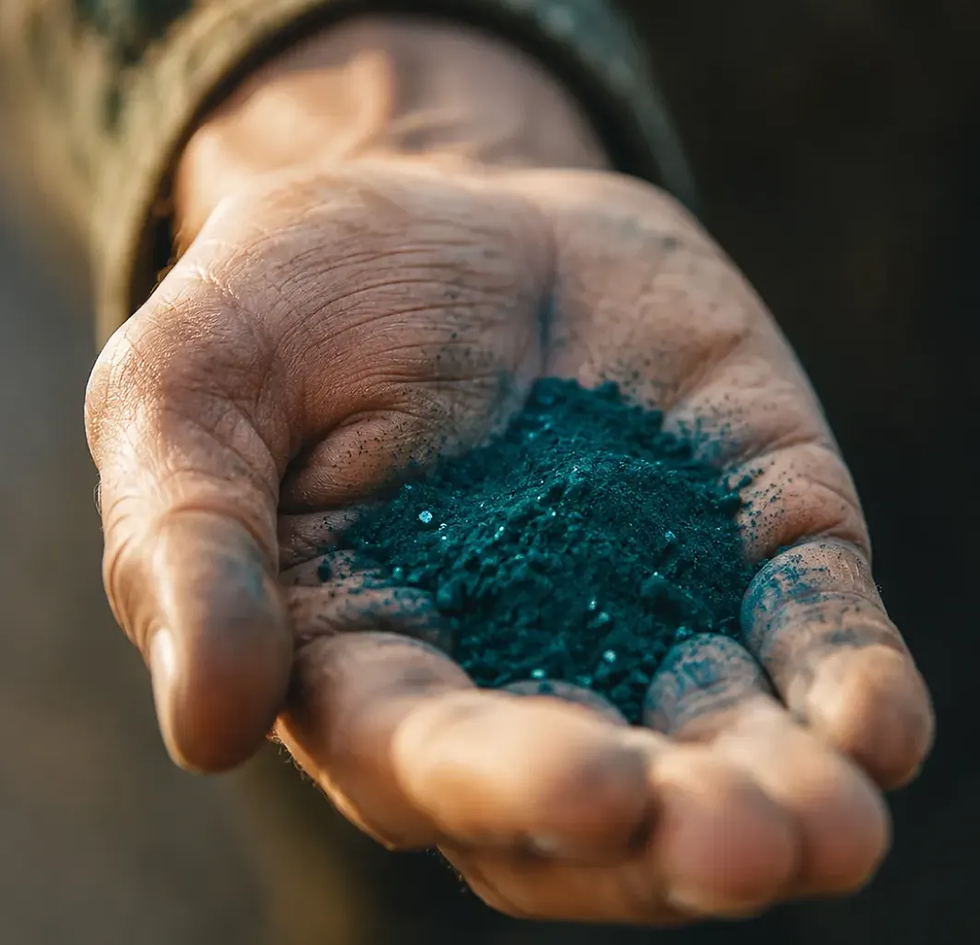
What if the reason this cyanobacterial pigment shows such broad biological activity across the research is not that it is a remarkable drug — but that your cells are, in part, descended from the organism that makes it?
This is the part of the work I love most. Not the cataloguing of studies — though there is something quietly thrilling about watching 107 abstracts resolve into a coherent portrait of a molecule the medical establishment has largely ignored. What I love is the moment when the pattern becomes visible. When the data stops being a list of therapeutic actions and starts being a story about who we are.
Modern science has a particular limitation that almost never gets named. It is not a limitation of intelligence or effort. It is a limitation of funding. What gets studied is, in large part, what can be patented. What can be patented is what can be isolated, synthesized, and sold. A pigment protein derived from a cyanobacterium that has been consumed by human ancestors for as long as there have been human ancestors — that is, by definition, unpatentable. Which means it falls outside the zone of serious pharmaceutical interest. Which means the literature that does exist represents a fraction of what would exist if the economics were different.
That is not a conspiracy. It is a structural reality. And it does not mean the science is absent. It means we have to be pioneers to find it.
The Ancestral Relationship: We Are, In Part, Cyanobacteria

The mitochondrion and the cyanobacterium — not analogy, but ancestry. Every human cell carries the descendant of this ancient partnership.
Start here, because everything else follows from it. Your mitochondria — the organelles inside every cell of your body that produce ATP, the currency of biological energy — are not originally human. They are, in the deepest sense, cyanobacteria.
Roughly 1.5 to 2 billion years ago, an ancient archaeal cell engulfed a cyanobacterium. Instead of digesting it, the two organisms struck an arrangement that would eventually produce every complex life form on Earth: the cyanobacterium traded its energy-production capacity for shelter and nutrition. That partnership became the eukaryotic cell. You are its descendant.
“Your mitochondria and spirulina’s phycocyanin-producing apparatus share a common ancestor. They are not strangers to each other. They are, in the most literal biological sense, relatives.”
This is not metaphor. It is the established scientific consensus on eukaryotic evolution. And its implications for how we understand phycocyanin’s activity in human tissue have been almost entirely unexplored.
Phycocyanin — specifically C-phycocyanin (C-PC), the dominant blue pigment protein of Spirulina — is a light-harvesting molecule. Its biological function in cyanobacteria is to capture photons and channel their energy into the electron transport chain. The electron transport chain that exists in your mitochondria. The same chain, evolutionarily continuous, now running on oxygen rather than light — but descended from the same ancient apparatus.
When you consume phycocyanin, you are not introducing a foreign pharmacological agent into your biology. You are reintroducing a molecule whose chemical language your cells have been reading — in one form or another — for two billion years.
The Chromophore: Where the Chemistry Becomes Unmistakable
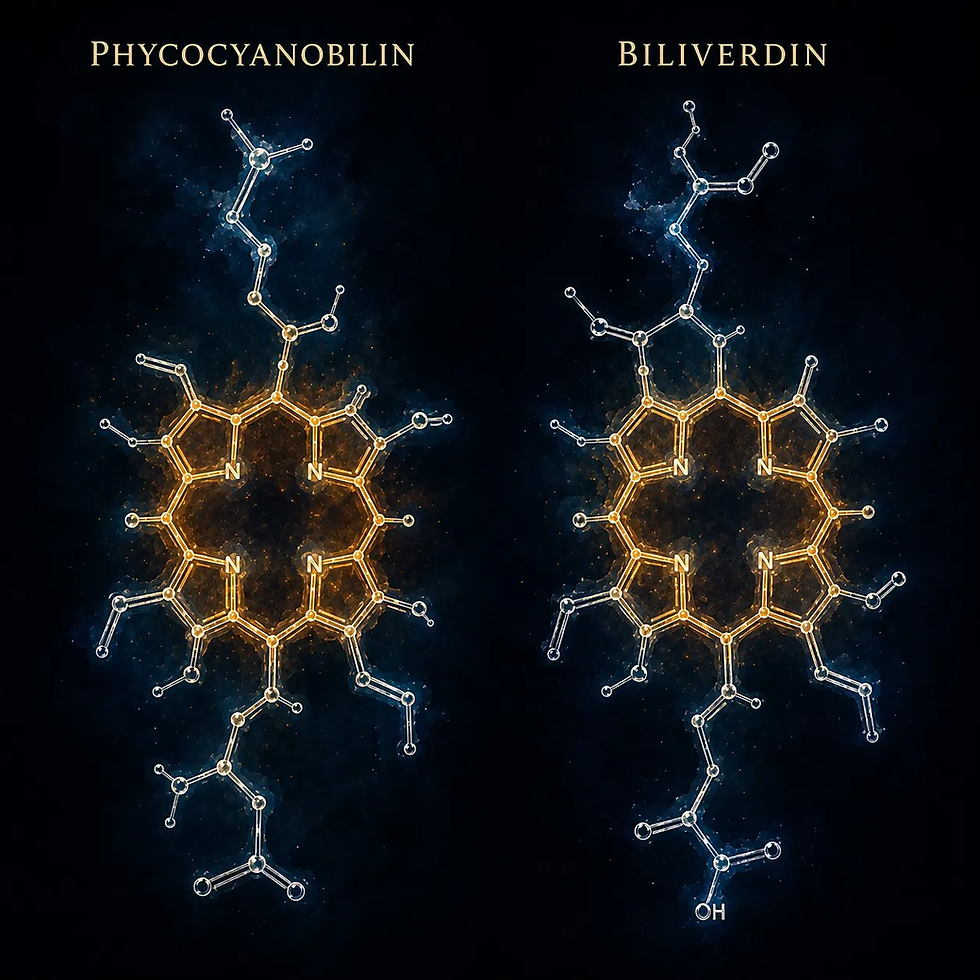
The active chromophore inside phycocyanin is phycocyanobilin — a tetrapyrrole ring structure. Look at that structure carefully, and then look at biliverdin, the heme breakdown product your own liver produces. They are near-identical. Biliverdin is your body’s precursor to bilirubin — the endogenous antioxidant that circulates in your blood and protects LDL from oxidation.
The tetrapyrrole ring is one of the most ancient and conserved molecular structures in all of biology. It is the core of chlorophyll. It is the core of heme. It is the structure your body produces, with extraordinary metabolic effort, to manage oxidative stress. And it is the structure at the heart of the pigment that gives spirulina its blue color.
This structural kinship explains something the literature documents but rarely accounts for: phycocyanin activates Nrf2, the master transcription factor that governs the body’s own antioxidant and cytoprotective response. Bilirubin — your own tetrapyrrole — is a natural Nrf2 activator. When phycocyanobilin enters the cell, the body may be reading it as a recognized signal. Not a drug. Not a supplement. A molecular communication it already knows how to receive.
What 107 Studies Reveal: A Literature Review
The GreenMedInfo database currently indexes 107 abstracts on phycocyanin and 58 documented pharmacological actions, yielding a Cumulative Knowledge Score of 173 and an overall research rating of Good.

The two highest-scoring pharmacological actions in the database are anti-inflammatory activity (40 abstracts, Cumulative Knowledge 64) and antioxidant activity (41 abstracts, CK 62). These are not niche findings. Inflammation and oxidation are two of the master regulatory processes in human physiology. What distinguishes phycocyanin is not the presence of these effects — it is the remarkable precision and multiplicity of the mechanisms through which they are achieved.
ANTI-INFLAMMATORY MECHANISMS
COX-2 inhibition (10 abstracts), NF-κB suppression (8 abstracts), TNF-alpha inhibition (13 abstracts), IL-6 downregulation (7 abstracts), IL-1β reduction, PGE2 suppression, IL-10 upregulation, and Nrf2/HO-1 pathway activation. A multi-target profile no single pharmaceutical can replicate.
A NOTE ON THE BREADTH OF THE LITERATURE
What’s striking about the phycocyanin research isn’t any single finding — it’s the range of fields engaged with it. The published literature spans neuroscience, oncology, cardiometabolic science, hepatic and renal physiology, immunology, and more, with most of the activity converging on two underlying mechanisms: the modulation of inflammatory signaling and the support of antioxidant defense.

I’m not going to summarize those clinical literatures here, for two reasons. First, this is an article about why a molecule might show such range — the ancestral argument — not a medical review. Second, the appropriate home for that body of research is the open database itself, where each abstract can be read in its original context. The full catalog of indexed studies — across every field of investigation — lives at GreenMedInfo’s phycocyanin entry, and I’d encourage anyone who wants the specifics to read the primary sources there rather than take my framing for it.
What matters for the argument I'm making is simpler: a single molecule has drawn serious scientific attention across an unusually wide range of human biology. The question this article asks is why — and the answer, I'll argue, is older than any of the individual studies.
The Co-Evolutionary Explanation: Why This Molecule Knows Us

The breadth of phycocyanin’s activity across 82 disease conditions is, on the surface, implausible. No single molecule should address cancer and Alzheimer’s and kidney disease and radiation damage and infertility and colitis. Unless the explanation is not that the molecule targets 82 conditions — but that it restores the regulatory conditions in which the body’s own intelligence can address them.
Consider the evolutionary timeline. Cyanobacteria oxygenated the atmosphere — a transformation that took hundreds of millions of years and made complex aerobic life possible. Vertebrate animals evolved in aquatic and semi-aquatic environments where cyanobacteria were at the base of the food web. The relationship between cyanobacterial molecular chemistry and animal physiology is not supplementary. It is foundational.
It is plausible that the inflammatory and antioxidant signaling systems of animals co-evolved in the presence of cyanobacterial chemistry. That NF-κB, Nrf2, and the cytokine networks were calibrated, over hundreds of millions of years of evolutionary pressure, in an environment where cyanobacterial pigment proteins were a regular feature of the biochemical landscape. That the absence of these molecules from the modern diet is not neutral — it is a deficit. And that the 82-condition footprint of phycocyanin in the literature is not a pharmacological curiosity but a biological signal: the body recognizing, and responding to, a chemistry it was shaped to expect.
“We are not consuming something alien. We are, in a sense, reintroducing a molecular conversation that industrial food systems interrupted.”
This is what it means to draw from ancient intelligence using modern science. The studies are necessary — they give us the precision, the mechanisms, the language of causality that the modern mind requires. But the deeper question the studies are answering was never a pharmacological one. It was an evolutionary one. Why does the blue pigment of a cyanobacterium restore order in human cells? Because human cells are, in part, cyanobacterial. Because the molecule is not foreign medicine. It is ancestral chemistry, finally coming home.
How Do You Take It?
Phycocyanin is one of those compounds where sourcing and form matter enormously. The difference between a meaningful dose and an inert one comes down to three things: purity grade, extraction method, and stability preservation. Here is what to look for, and how to think about incorporating it.

Purity Grade
Phycocyanin is graded by “color value” — a measure of absorbance at 618nm that reflects the concentration of active pigment. The most common commercial forms of blue-green algae typically run between 1–3% of dry weight. For encapsulated forms taken with in doses of physiological relevance, look for 25% concentrations or above. A dedicated phycocyanin extract delivers meaningfully more active compound per gram, and is more likely to be taken daily than the powder form.
Extraction and Stability
Phycocyanin is a protein, and proteins degrade. Heat, light, and prolonged exposure to water all compromise its activity. Freeze-drying (lyophilization) is the gold standard preservation method — it retains a substantially higher concentration of functional molecules than heat-based drying. When evaluating any phycocyanin product, look for cold-processed or freeze-dried on the label. Avoid products that have been sitting in clear containers exposed to light, or formulations that use heat-intensive manufacturing processes.
Dosing: What the Research Suggests
Most of the research on phycocyanin uses doses in the range of 100–300mg of purified C-phycocyanin per day for systemic anti-inflammatory and antioxidant effects. Some human studies — including the ACE human trial cited in this review — used formulations delivering phycocyanin as part of a broader spirulina-derived complex. As with most whole-food-derived compounds, consistency over weeks rather than single large doses appears to be the pattern the research supports. On an empty stomach first thing in the morning is generally considered optimal for absorption.
Sources Worth Knowing
The market for phycocyanin ranges from high-integrity to inert. A few benchmarks worth knowing when evaluating sources:
Whole spirulina powder (organic, cold-processed) — the most accessible entry point. Look for USDA Organic certified, Arthrospira platensis, with no fillers or flow agents. Provides phycocyanin alongside the full complement of co-factors including chlorophyll, phycoerythrin, and accessory pigments. Dose: 3–5g daily. Add to water, smoothies, or juice. The flavor is mild when the quality is high.
Blue spirulina extract (phycocyanin isolate) — the concentrated form, stripped of chlorophyll and most of the green pigment, leaving a vivid cobalt-blue powder. Delivers more phycocyanin per gram than whole spirulina. Look for freeze-dried, no fillers, purity-graded. Works well dissolved in cold water or added to light-colored drinks where you want the blue without the green. Dose: 0.5–1g daily.
Encapsulated phycocyanin complexes — when phycocyanin is formulated with complementary compounds that stabilize the protein and enhance bioavailability, including lipid carriers or co-factors that support the electron transport activity the molecule is known for. This is where formulation intelligence matters most.
A NOTE ON STIMULANT-FREE ENERGY Most energy products work by stimulating the adrenal-sympathetic axis — caffeine, guarana, B-vitamin megadoses, adaptogens that push cortisol. The come-up is real. So is the crash, and the cumulative load on the nervous system over months and years of use. Phycocyanin’s energy-supporting mechanism is categorically different. It works at the level of the electron transport chain — the same chain your mitochondria use to generate ATP. Rather than borrowing energy from tomorrow, it supports the conditions under which your cells generate energy today. No stimulant effect. No adrenal load. No crash.This distinction matters most for people who are already running on reserves — those managing chronic inflammation, post-viral fatigue, or the accumulated oxidative load of a high-demand life. For these individuals, the last thing the system needs is another stimulant. What it needs is substrate: the molecular raw material for the electron transport chain to do its work properly. That is precisely what phycocyanin provides.
A Formulation I Built Around This
The research on phycocyanin is what led me to formulate with it. I wanted a version that respected what makes the molecule worth taking in the first place — so MethylateBLUE™ is organically produced, freeze-dried to protect the fragile pigment, and concentrated to roughly 50% phycocyanin.
It isn’t an energy drink and it isn’t an adaptogen stack. I paired the phycocyanin with co-factors I chose to support the body’s own cellular energy machinery — including fermented nicotinamide, a precursor your cells use in the NAD⁺ pathway. The idea was simple: work with the chemistry described above rather than around it.
If the science here interests you the way it does me, you can see the full formula and the thinking behind it on the product page.


Comments